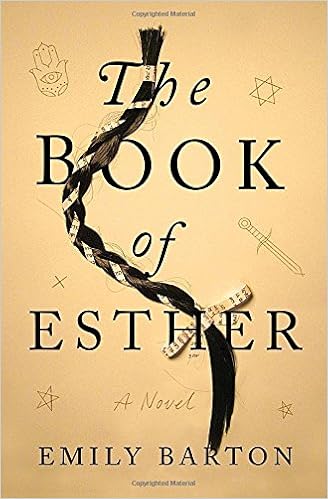
The Book of Esther by Emily Barton


The Book of Esther by Emily Barton

Set in Eastern Europe in 1942, in a small of nation of warrior Turkic Jews, Emily Barton has given us a novel that brings together historical vision, well-developed characters, and a plotline that moves along steadily.  The main character, Esther, is a conglomeration of wisdom, shrewdness, and prophet, seeing the way in which events will soon turn out ahead of time.  The women in the community forge traditional older ways of living with an eye towards mercy, helping those refugees who flee into the land with knitted hats, scarfs, and other wearable items. 

One of the beautiful ways that Barton develops and brings out the character of Esther is through the combination of her received religious tradition and her experience of life as she leaves her father Josephus.  Barton writes, “For three years, Esther, a legal adult had fasted on Yom Kippur, but that was different: spiritual in nature but for a purpose.  And on the Day of Atonement all one did was pray and fast.  Today, they’d ridden like Mongol warriors since dawn.  Her back hurt, her legs thrummed…Her body needed food (46).”  There is a memory of fasting and hunger but this was for a spiritual and religious purpose, and yet, her hunger on this road to war was also for a purpose, one which she didn’t presently fully understand.

Another aspect that caught my attention in the story was Seleme, the mechanical horse that ran on a 150cc engine.  Barton keenly describes the horse as having much the characteristics of a fighting bull, “Seleme had been designed for war: to charge, to do battle, to retreat when necessary.  All of her sensory apparatus now engaged.  Her ears swiveled to the sides,…(70).”  Esther quickly finds out that her father’s use of available fuel and mechanic’s work on Seleme was something she did not possess, but learned how to find the right fuel.  In the desire to save Khazaria, Esther found a friend in her battle ready mechanical horse, Seleme, even surprising many on her journey, even the ferry man. 

Seeking to save Khazaria from Germania, Esther sets out on a journey with little but a friend, a mechanical horse, and a wholehearted desire to do harm to her enemies.  A bit of alternative history and reminiscent of the character in the Bible, Esther is a woman on a mission.  This story through all its twists and turns is worth reading.

Thanks to Blogging for Books for the copy of this book in exchange for an honest review

Comments

Popular posts from this blog

Saving Casper

Saving Casper: A Christian and an Atheist Talk about Why We Need to Change the Conversion Conversation by Jim Henderson and Matt Casper http://www.amazon.com/Saving-Casper-Christian-Conversion-Conversation/dp/1414364881 Many readers will quickly know the authors of this book from their previous release Jim and Casper Go to Church.  Jim and Matt’s new book entitled Saving Casper focuses on the way we talk about conversion in the church and the devastating ways we have pushed away atheists and other non-believers by our posture.  Both Jim and Matt traversed the national landscape, meeting in churches and asking hard questions about faith, conversion, and life. The basic premise of the book and travel is laid out here in their words, “Part of what Casper and I are trying to achieve when we speak to a group of Christians is to help people move a little bit on their “judgment meter.”  This capacity, while intellectually and often theologically uncomfortable,...

Essential Christian Doctrine

  Essential Christian Doctrine , General Editor John MacArthur Pastor John MacArthur has for years been teaching the Word of God in both pulpit ministry, books, and conferences with an aim to displaying God’s revelation to his listeners in a winsome and foundational manner.  This new book, Essential Christian Doctrine takes an entire life of teaching and preaching and encapsulates the main contours of the Christian faith for its readers.  John in a systematic way highlights the most necessary teachings from Scripture including God’s Word, the Trinity, while also including sections on Man and the Future. One of the most helpful ways the authors bring to light biblical truth and theology is the way in which they group together particular themes.  In the section on the Holy Spirit, instead of a complex discussion of personhood, word pictures of the Holy Spirit are introduced in a discernible and profitable manner.  The metaphors for the Holy Spirit include fir...

God's Grace for All of Life

The Romance of Grace by Jim McNeely III To be honest, when I received this book in the mail I had visions of what it might be like with a title like, ‘The Romance of Grace.’  The emotional rollercoaster and one-sided perspective on how our emotions fuel our faith was my presumption about the book, but this was the furthest thing from the truth as I started reading.  The Romance of Grace by Pastor Jim McNeely III is a careful look at the movements of grace in the way God pursues us with his love and his desire to get us to love him back.  McNeely writes, “We are entering a cosmic romance with a passionate lover, and He is interested in our heart’s truest desire.  His deepest objective isn’t to make us more moral; it is to get us to love Him back.  Virtue is the fruit, not the root” (18).  Why is this helpful?  For one thing, beginning with God’s initiating grace frees us from starting out on the wrong foot in the way we tell the story and...