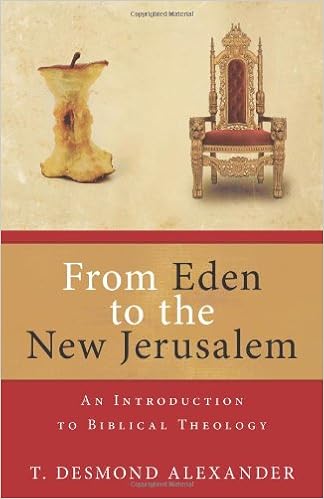
From Eden to the New Jerusalem


From Eden to the New Jerusalem by T. Desmond Alexander

Biblical theology is a discipline of theology that brings together the best of a biblically faithful hermeneutic while looking at the overarching story in the Scriptures, from Genesis to Revelation.  Often, especially in covenant theological circles, the overwhelming emphasis is on the covenant structure of the Bible and how these covenants ultimately lead towards the new covenant, culminating in Christ.  While this approach is very good, often other themes in Scripture fall by the wayside, such as throne, garden, city, and the restoration of all things in Christ.  T. Desmond Alexander, in his book, From Eden to the New Jerusalem, in his succinct and pointed manner draws our attention to the big ideas of Scripture that form the basis of biblical theology from the sacred garden to the holy city, and the throne of God to the establishment of the living God’s dwelling with men in the final chapter.

Early on in the first chapter, Alexander points out that the Garden of Eden is portrayed as a sanctuary in which, “The Lord God walks in Eden as he later does in the tabernacle and the river flowing from Eden is reminiscent of Ezekiel 47:1-12, which envisages a a river flowing from a future Jerusalem temple and bringing life to the Dead Sea” (23).  From these points Alexander makes the conclusion that Adam and Eve acted in a priestly manner because they met God in a holy place, a place endued with grandeur and glory that reflected all the wonderful attributes of God’s character.  Further, the parameters of Eden were to be extended over all the Earth, so that the sanctuary was to be enlarged as the nation of Israel was formed, thereby encompassing and making the average Israelite a royal priest in the service of God.  This service was not just to be a Levitical priest’s duty but was to fall under the task of subduing the earth.

Desmond rightfully points to the fall of Adam and Eve as having deleterious consequences for the face of humanity.  Not least of these consequential sins was the promotion of violence.  He writes, “The divine ordering of creation is rejected by the human couple, with disastrous consequences for all involved.  Harmony gives way to chaos.  As the early chapters of Genesis go on to reveal, people exercise dominion in the cruelest of ways.  Violence towards other creatures, both human and animal, is the hallmark of fallen humanity” (79).  The shedding of blood from Cain on towards the ways in which God’s heart was grieved that he made man all point to escalation of violence.  On this fifteenth anniversary of 9/11, we still feel the costliness of violence and the terror that ensues from such egregious acts. 

Alexander’s emphasis on the throne of God, the restoration of all creation, and his helpful work in the last two chapters of Revelation go a long way in giving the reader a better grasp of a narrative biblical theology.

Thanks to Kregel Academic for the copy of this book in exchange for an honest review.


Comments

Popular posts from this blog

Saving Casper

Saving Casper: A Christian and an Atheist Talk about Why We Need to Change the Conversion Conversation by Jim Henderson and Matt Casper http://www.amazon.com/Saving-Casper-Christian-Conversion-Conversation/dp/1414364881 Many readers will quickly know the authors of this book from their previous release Jim and Casper Go to Church.  Jim and Matt’s new book entitled Saving Casper focuses on the way we talk about conversion in the church and the devastating ways we have pushed away atheists and other non-believers by our posture.  Both Jim and Matt traversed the national landscape, meeting in churches and asking hard questions about faith, conversion, and life. The basic premise of the book and travel is laid out here in their words, “Part of what Casper and I are trying to achieve when we speak to a group of Christians is to help people move a little bit on their “judgment meter.”  This capacity, while intellectually and often theologically uncomfortable,...

Essential Christian Doctrine

  Essential Christian Doctrine , General Editor John MacArthur Pastor John MacArthur has for years been teaching the Word of God in both pulpit ministry, books, and conferences with an aim to displaying God’s revelation to his listeners in a winsome and foundational manner.  This new book, Essential Christian Doctrine takes an entire life of teaching and preaching and encapsulates the main contours of the Christian faith for its readers.  John in a systematic way highlights the most necessary teachings from Scripture including God’s Word, the Trinity, while also including sections on Man and the Future. One of the most helpful ways the authors bring to light biblical truth and theology is the way in which they group together particular themes.  In the section on the Holy Spirit, instead of a complex discussion of personhood, word pictures of the Holy Spirit are introduced in a discernible and profitable manner.  The metaphors for the Holy Spirit include fir...

God's Grace for All of Life

The Romance of Grace by Jim McNeely III To be honest, when I received this book in the mail I had visions of what it might be like with a title like, ‘The Romance of Grace.’  The emotional rollercoaster and one-sided perspective on how our emotions fuel our faith was my presumption about the book, but this was the furthest thing from the truth as I started reading.  The Romance of Grace by Pastor Jim McNeely III is a careful look at the movements of grace in the way God pursues us with his love and his desire to get us to love him back.  McNeely writes, “We are entering a cosmic romance with a passionate lover, and He is interested in our heart’s truest desire.  His deepest objective isn’t to make us more moral; it is to get us to love Him back.  Virtue is the fruit, not the root” (18).  Why is this helpful?  For one thing, beginning with God’s initiating grace frees us from starting out on the wrong foot in the way we tell the story and...