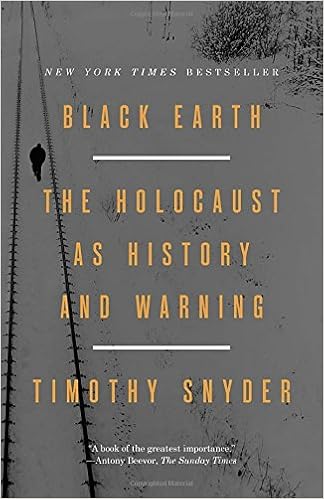
Black Earth: The Holocaust as History and Warning


Black Earth: The Holocaust as History and Warning by Timothy Snyder

Misperceptions, misconnections, and missed observations are just some of the issues that Timothy Snyder raises in his book, Black Earth, concerning the Holocaust.  Snyder, no stranger to the frontlines of scholarship on the Holocaust, with his previous book Bloodlands, that concerns the land from Hitler to Stalin, takes a look at the Holocaust from new sources and new avenues of thought.  How did some nation-states survive relatively unscathed from Nazi persecution while others, notably Jewish populations, succumb to a wave of killings?  Also, what was the role of the Soviet Union in the war and how did Stalin effect changes in the Final Solution?  These questions are only two of the many that Snyder answers in his detailed account of the Holocaust.

One of the best chapters was entitled The Auschwitz Paradox.  Generally when the public thinks about the Holocaust, we think of Auschwitz first or at the top of our mental map.  Snyder writes, “The word “Auschwitz” has become a metonym for the Holocaust as a whole.  Yet the vast majority of Jews had already been murdered, further east, by the time that Auschwitz became a major killing facility.  Yet while Auschwitz has been remembered, most of the Holocaust has been largely forgotten (207).”  It isn’t that Auschwitz isn’t an important point in Holocaust discussion, but “The mass murder of Jews was known and discussed in Germany, at least among families and friends, long before Auschwitz became a death facility.”  Three years leading up to the construction and installation of Auschwitz, Jews were routinely executed and killed east of this dreadful killing site. 

A second aspect of the book that shows evidence of the systematic nature of Germany as state destroyers is seen in the country of Poland.  “The Polish central government was destroyed, Polish law was abolished, and the Polish state was declared to have never existed…There were no longer ministries and there were no longer citizens.  Instead, local authorities were made personally responsible for the implementation of German racial policies.  They oversaw the deportation of Poland’s Jews and the distribution of property not taken by the Germans (110).”  One of the major goals for Hitler’s eradication of the Polish nation was to take down the Polish elites, so that the governing and respected authorities would no longer influence the masses.  A dreadful fear cast its ugly shadow on the Polish people and for many it was follow these horrendous policies or be killed.

This was an extraordinary book to say the least.  Snyder helps the reader understand how such Final Solution policies could slowly but surely cover vast nation states by looking at their implementation.  I think all who are interested in how the Holocaust took place and what ways nation states act similarly should read this book.


Thanks to Blogging for Books for the copy of this book in exchange for an honest review.

Comments

Popular posts from this blog

Saving Casper

Saving Casper: A Christian and an Atheist Talk about Why We Need to Change the Conversion Conversation by Jim Henderson and Matt Casper http://www.amazon.com/Saving-Casper-Christian-Conversion-Conversation/dp/1414364881 Many readers will quickly know the authors of this book from their previous release Jim and Casper Go to Church.  Jim and Matt’s new book entitled Saving Casper focuses on the way we talk about conversion in the church and the devastating ways we have pushed away atheists and other non-believers by our posture.  Both Jim and Matt traversed the national landscape, meeting in churches and asking hard questions about faith, conversion, and life. The basic premise of the book and travel is laid out here in their words, “Part of what Casper and I are trying to achieve when we speak to a group of Christians is to help people move a little bit on their “judgment meter.”  This capacity, while intellectually and often theologically uncomfortable,...

Essential Christian Doctrine

  Essential Christian Doctrine , General Editor John MacArthur Pastor John MacArthur has for years been teaching the Word of God in both pulpit ministry, books, and conferences with an aim to displaying God’s revelation to his listeners in a winsome and foundational manner.  This new book, Essential Christian Doctrine takes an entire life of teaching and preaching and encapsulates the main contours of the Christian faith for its readers.  John in a systematic way highlights the most necessary teachings from Scripture including God’s Word, the Trinity, while also including sections on Man and the Future. One of the most helpful ways the authors bring to light biblical truth and theology is the way in which they group together particular themes.  In the section on the Holy Spirit, instead of a complex discussion of personhood, word pictures of the Holy Spirit are introduced in a discernible and profitable manner.  The metaphors for the Holy Spirit include fir...

God's Grace for All of Life

The Romance of Grace by Jim McNeely III To be honest, when I received this book in the mail I had visions of what it might be like with a title like, ‘The Romance of Grace.’  The emotional rollercoaster and one-sided perspective on how our emotions fuel our faith was my presumption about the book, but this was the furthest thing from the truth as I started reading.  The Romance of Grace by Pastor Jim McNeely III is a careful look at the movements of grace in the way God pursues us with his love and his desire to get us to love him back.  McNeely writes, “We are entering a cosmic romance with a passionate lover, and He is interested in our heart’s truest desire.  His deepest objective isn’t to make us more moral; it is to get us to love Him back.  Virtue is the fruit, not the root” (18).  Why is this helpful?  For one thing, beginning with God’s initiating grace frees us from starting out on the wrong foot in the way we tell the story and...