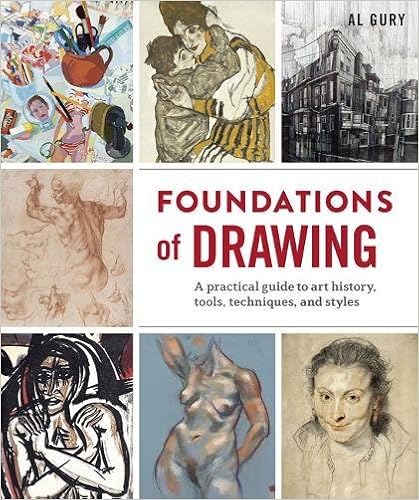
Foundations of Drawing


As a father to a little daughter who loves to draw, engage in creative imaginative painting efforts, and altogether enjoys designing dog clothes, my interest was piqued by this fascinating book called Foundations of Drawing by Al Gury.  I was glad to receive this book and even more happy to read through the history of how drawing, illuminating, and model drawing was part of many cultures, making alive the world that we see everywhere.  Al Gury is a wise guide, holding the chair of the painting department at the Pennsylvania Academy of the Fine Arts in Philadelphia.  Here are a few of the most fascinating points of the book for me.

One, Al Gury gets into the nitty gritty world of the Medieval period which book illumination and scriptoria, where monks would work at studying, copying, and translating ancient works, even works written papyrus, for their preservation.  Unique for the artistic mind, there were elegant illustrations and decorations done in pen and ink, and colored with water-based pigments.  Ornamented classic Greek and Roman works were found in these scriptoriums, devoted to the preservation of ancient texts so that others could learn and disseminate the learning of the great works of civilization.  Early Latin Bibles were produced with significant illustrations that befitted the narratives of the 66 books included in the biblical canon.

Gury also mentions in the book the push for a national program of artistic endeavors by certain countries.  He writes, "By controlling art education and access to lucrative government commissions, the goal of these national academies was to produce professional painters and sculptors whose careers would uphold the values of the state, the academies, and their aesthetic and political goals." (22)  Many of the official academies strongly pushed classical form and closed line form rather than the more emotive and expressive philosophies such as Romanticism.  But, this was to the advantage of the both the academy and the artist in many ways, giving the artist a strong post to work from that would not be taken away by poor patron funding.

Overall, this book was a very good introduction to the world of drawing, focusing on figures, history, method and tools.  I know my daughter as she gets older will appreciate this work.

Thanks to Blogging for Books for the copy of this book in exchange for an honest review.

Comments

Popular posts from this blog

Saving Casper

Saving Casper: A Christian and an Atheist Talk about Why We Need to Change the Conversion Conversation by Jim Henderson and Matt Casper http://www.amazon.com/Saving-Casper-Christian-Conversion-Conversation/dp/1414364881 Many readers will quickly know the authors of this book from their previous release Jim and Casper Go to Church.  Jim and Matt’s new book entitled Saving Casper focuses on the way we talk about conversion in the church and the devastating ways we have pushed away atheists and other non-believers by our posture.  Both Jim and Matt traversed the national landscape, meeting in churches and asking hard questions about faith, conversion, and life. The basic premise of the book and travel is laid out here in their words, “Part of what Casper and I are trying to achieve when we speak to a group of Christians is to help people move a little bit on their “judgment meter.”  This capacity, while intellectually and often theologically uncomfortable,...

Essential Christian Doctrine

  Essential Christian Doctrine , General Editor John MacArthur Pastor John MacArthur has for years been teaching the Word of God in both pulpit ministry, books, and conferences with an aim to displaying God’s revelation to his listeners in a winsome and foundational manner.  This new book, Essential Christian Doctrine takes an entire life of teaching and preaching and encapsulates the main contours of the Christian faith for its readers.  John in a systematic way highlights the most necessary teachings from Scripture including God’s Word, the Trinity, while also including sections on Man and the Future. One of the most helpful ways the authors bring to light biblical truth and theology is the way in which they group together particular themes.  In the section on the Holy Spirit, instead of a complex discussion of personhood, word pictures of the Holy Spirit are introduced in a discernible and profitable manner.  The metaphors for the Holy Spirit include fir...

Wisdom for All

Interpreting the Wisdom Books: An Exegetical Handbook by Edward Custis Among the many wonderful books on the OT wisdom literature, this fine new book helps the reader interpret, exegete, and apply God’s Word to his people in succinct and helpful way.  The book is laid out nicely with bolded words that emphasize necessary themes in the study of the wisdom books and short chapters that get to the point of the biblical books.  This series of exegetical handbooks is a great treasure for students and pastors because it synthesizes much of the academic work on a biblical book into digestable portions helpful  for preaching and teaching. The opening chapter on the wisdom books brings out a helpful grid for understanding wisdom literature.  Custis writes, “Biblical wisdom, in contrast to Israel’s neighbors, reflects “Yahwistic theology” through its regular use of terms like “fear of the Lord,” its affirmation of God’s providence, and its recognition th...