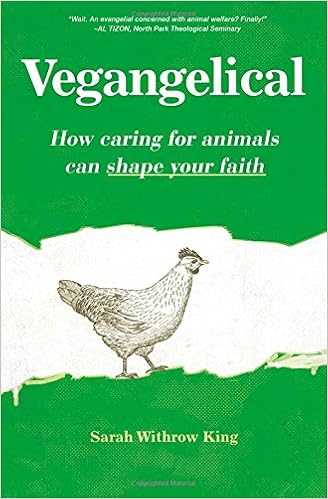
Vegangelical


Vegangelical: How caring for animals can shape your faith by Sarah Withrow King

What difference does caring for animals make and is it really a matter of justice?  Sarah Withrow King in her new book, Vegangelical, answers these questions and more as she draws together the rich tapestry of Scripture concerning creation and her research on the use and abuse of animals in our world.  What turns out to be no so much an apology for the vegan way of life, but a vision for how to rightly treat animals and how God has made the world in such a way as to promote the flourishing of all of creation.

Drawing on her experience picking up a booklet on the suffering of animals and their use for food, Sarah was propelled to stop eating meat, join PETA and advocate for animals and oppose testing on them (14-17).  Yet, there was a certain disconnect between those in the church who were like-minded with Sarah and a whole host of others who thought Christianity had little to do with animals.  It was in seminary that she also began to connect the two, seeing in the Scriptures and in theology a way of affirming her love for animals and advocacy on their behalf. 

Sarah brings together some key theological foundations that help undergird her perspective on animals.  One, how does the image of God in man relate to the treatment of animals?  Second, “what does it mean to steward creation?”  And third, “how are we called to extend mercy to the least of these and who is our neighbor (25)?”  The section in chapter 3 devoted to loving the least of these and our neighbor has some excellent points.  Sarah writes, “Exclusion by assimilation demands the subject of exclusion to give up their identity, to be subsumed into the identity of the dominant power.  The animals we keep as pets, in zoos, and in circuses fall into this category (70-71).”  These animals are transplanted from their natural environment into a man designed one, often with consequences.  This master/subject relationship gives the upper hand to the owner, and yet there is a slice of mercy here, since many pet owners lovingly take care of their animals, in sickness and in plenty. 

At times, the book seemed to be overdone with the endless Scriptural quotations and exposes of the treatment of animals.  But, I do believe Sarah’s point about bringing us back to a healthy understanding of God, animals, and neighbor is on target.


Thanks to BookLookBloggers and Zondervan for the copy of this book in exchange for an honest review.

Comments

Popular posts from this blog

Saving Casper

Saving Casper: A Christian and an Atheist Talk about Why We Need to Change the Conversion Conversation by Jim Henderson and Matt Casper http://www.amazon.com/Saving-Casper-Christian-Conversion-Conversation/dp/1414364881 Many readers will quickly know the authors of this book from their previous release Jim and Casper Go to Church.  Jim and Matt’s new book entitled Saving Casper focuses on the way we talk about conversion in the church and the devastating ways we have pushed away atheists and other non-believers by our posture.  Both Jim and Matt traversed the national landscape, meeting in churches and asking hard questions about faith, conversion, and life. The basic premise of the book and travel is laid out here in their words, “Part of what Casper and I are trying to achieve when we speak to a group of Christians is to help people move a little bit on their “judgment meter.”  This capacity, while intellectually and often theologically uncomfortable,...

Essential Christian Doctrine

  Essential Christian Doctrine , General Editor John MacArthur Pastor John MacArthur has for years been teaching the Word of God in both pulpit ministry, books, and conferences with an aim to displaying God’s revelation to his listeners in a winsome and foundational manner.  This new book, Essential Christian Doctrine takes an entire life of teaching and preaching and encapsulates the main contours of the Christian faith for its readers.  John in a systematic way highlights the most necessary teachings from Scripture including God’s Word, the Trinity, while also including sections on Man and the Future. One of the most helpful ways the authors bring to light biblical truth and theology is the way in which they group together particular themes.  In the section on the Holy Spirit, instead of a complex discussion of personhood, word pictures of the Holy Spirit are introduced in a discernible and profitable manner.  The metaphors for the Holy Spirit include fir...

Wisdom for All

Interpreting the Wisdom Books: An Exegetical Handbook by Edward Custis Among the many wonderful books on the OT wisdom literature, this fine new book helps the reader interpret, exegete, and apply God’s Word to his people in succinct and helpful way.  The book is laid out nicely with bolded words that emphasize necessary themes in the study of the wisdom books and short chapters that get to the point of the biblical books.  This series of exegetical handbooks is a great treasure for students and pastors because it synthesizes much of the academic work on a biblical book into digestable portions helpful  for preaching and teaching. The opening chapter on the wisdom books brings out a helpful grid for understanding wisdom literature.  Custis writes, “Biblical wisdom, in contrast to Israel’s neighbors, reflects “Yahwistic theology” through its regular use of terms like “fear of the Lord,” its affirmation of God’s providence, and its recognition th...